Home   |   LCS Prints Store   |   About Me   |   FAQ   

Wednesday, November 2, 2022

How it is Now - IWSG November 2022.

Welcome to IWSG Day. The goal of this blog hop is to share and encourage. Writers can express doubts and concerns without fear of appearing foolish or weak. Those who have been through the fire can offer assistance and guidance. It’s a haven for insecure writers of all kinds. IWSG is the brainchild of the amazing and generous  Alex Cavanaugh. To find links to other monthly contributors, click here.  Thank you to November co-hosts: Diedre Knight, Douglas Thomas Greening, Nick Wilford, and Diane Burton!


The writing hasn’t been kind to me lately. Back in the day when I felt stuck, I took an artist’s date which I learned to do while completing the lessons in The Artist's Way, by Julia Cameron. The writer suggests taking regular time-outs from your "art" to pursue an activity that might spur creativity. For me, that usually involved going on a walk with a camera. I’d click images of scenes around the area I love so much, then go home and write about something I'd photographed. Once I wrote a vignette about a house blurred by fog and it ended up inspiring my third novel.

But because of life (and cell phones), I haven’t taken a walk with my actual camera in a long time. When I took it out of the cupboard recently, the last photo on the memory card was from 2019.

A few days later, I took a ride down to the harbor with the camera in the passenger seat, just to see how it felt. In truth, it felt weird. Who uses an actual camera now, anyway? But really the issue was something biggerI didn’t grow up near the ocean. After almost 40 years of living by the sea, I’m still in awe of  my surroundings but as in every other realm of my life these days, there's something missing. 

Before two years ago, my walking habit was to keep my eyes open and frame picture after picture trying to capture the essence of what made me feel so joyful. These days though, what used to feel fun is hard work. Nevertheless, as flat as I felt that afternoon at the harbor, I was there. The egrets were, too. My heart wasn't in it much, but it gave me a little peace when I got home and downloaded the pictures to find my eyes still work.


Wednesday, October 5, 2022

Ye Old Red Pen - IWSG October 2022


Welcome to IWSG Day. The goal of this blog hop is to share and encourage. Writers can express doubts and concerns without fear of appearing foolish or weak. Those who have been through the fire can offer assistance and guidance. It’s a haven for insecure writers of all kinds. IWSG is the brainchild of the amazing and generous  Alex Cavanaugh. To find links to other monthly contributors, click here. Thank you to October co-hosts : Tonja Drecker, Victoria Marie Lees, Mary Aalgaard, and Sandra Cox.


I am always impressed when someone tells me they write their first drafts longhand. Imagine a 19th century author composing a manuscript with a quill pen, tying up the draft with string to deliver to a publisher (my imagination at work here). It’s more than I can fathom. Even ball-point pen on a lined legal pad feels daunting to me. Without the arrival of the personal computer, I’m confident I would not be a writer. My practice goes something like this. Stare into space for a while. Write a sentence. Write a paragraph. Decide the paragraph doesn’t say what I want it to. Delete most of it. Start again. In longhand, my drafts would be page after page of scratch outs.

That said, there’s nothing like printing out a draft and editing by hand. For the past year-and-a-half, I’ve been revising the first novel I ever tried to write. All those years ago I stopped working on it because the thing was such a complete mess, it was beyond my skills to fix it. I’m a better writer now. I pulled it out a few months after my husband died because the gosh-awful draft required focus. Focus provides distraction. Distraction helped me cope.

Now, I’ve gone through two revisions based on a fair bit of critiquing, which has helped improve the story to a point where I kind-of-sort-of thought maybe it was getting somewhere. With that in mind, I printed it out to read it from a different perspective.

Ugh.

Can you spell o-v-e-r-w-h-e-l-m-e-d? I'm only eighty pages in, and the majority of them look like this. 


Have you ever drafted out a story longhand? 

Do you print your stories out to edit them?

Wednesday, September 7, 2022

Nope, Nope, Nope, and I Wish


Welcome to IWSG Day. The goal of this blog hop is to share and encourage. Writers can express doubts and concerns without fear of appearing foolish or weak. Those who have been through the fire can offer assistance and guidance. It’s a haven for insecure writers of all kinds. IWSG is the brainchild of the amazing and generous  Alex CavanaughThank you to September co-hosts:  Kim Lajevardi, Cathrina Constantine, Natalie Aguirre, Olga Godim, Michelle Wallace, and Louise - Fundy Blue! To find links to other monthly contributors, click here.

This month’s optional question: What genre would be the worst one for you to tackle and why?

In real life as well as fiction, I stay away from anything that might lead to a sleepless night, which means no horror for me. I write because I love getting lost in other worlds (and words), not to increase my heart rate. Somewhere on this blog I wrote about a summer roommate who wouldn’t leave me alone until I agreed to read Stephen King’s Salem’s Lot. About a third of the way through, I tossed the book across the room. It sat in the corner until we weren’t roommates anymore. As with my reading, so goes my writing.

As for other genres, well, erotica is out, I don’t feel like I have the voice in my head for YA and, being the ultimate panster, it’s unlikely I could write a mystery because that would require making a plan. (In high school I wrote my papers before the required outline since it was the only way I could figure out what to write.) Other than moon-to-earth big picture, I don’t have much of a clue as to where my stories are going until they get there. Once they do, I spend eons editing the the heck out of them, paring them to final form. Not the most efficient way to write, but here we are…

In that regard, I have the utmost admiration for authors of historical fiction. Most recently, I read The Rose Code, by Kate Quinn, whose story portrays British civilians trained to break German military codes during the war. If I dove into something that complex, I doubt I’d resurface from the research, never mind demonstrate the skill to write about it. It takes a lot of organization and confidence to embark on a story with such depth.  

Sometimes, I wish my wiring worked that way.

What would be the most difficult kind of story for you to write?


Wednesday, August 3, 2022

Giving What They Want/Getting What I Want - IWSG August 2022


Welcome to IWSG Day. The goal of this blog hop is to share and encourage. Writers can express doubts and concerns without fear of appearing foolish or weak. Those who have been through the fire can offer assistance and guidance. It’s a haven for insecure writers of all kinds. IWSG is the brainchild of the amazing and generous  Alex Cavanaugh. Thank you to the August co-hosts: Tara Tyler, Lisa Buie Collard, Loni Townsend, and Lee Lowery! To read other contributors to IWSG click here.

August optional question: When you set out to write a story, do you try to be more original, or do you try  give readers what they want?

Confession? I set out to write a story, all I want to do is get something readable onto the page!

That said, it seems to me anyone who writes in a specific genre is trying to give a reader what they want. I write women’s fiction so in each of my stories the main character is a woman who has encountered some significant life-challenge she needs to overcome. That’s what my readers should want to read. To keep them immersed, though, the details need to be unique and compelling.

Recently, I was reading The Last Thing He Told Me, by Laura Dave, and something completely unexpected happened in the action.  “Oh. My. God." I said. Apparently my exclamation was on the energetic side because my daughter poked her head in from the other room.

“What’s wrong?”

“Sorry. It's all good. I’m  reading and the story surprised me.”

My daughter may have rolled her eyes, but I thought, Holy Moly, that's some writing! 


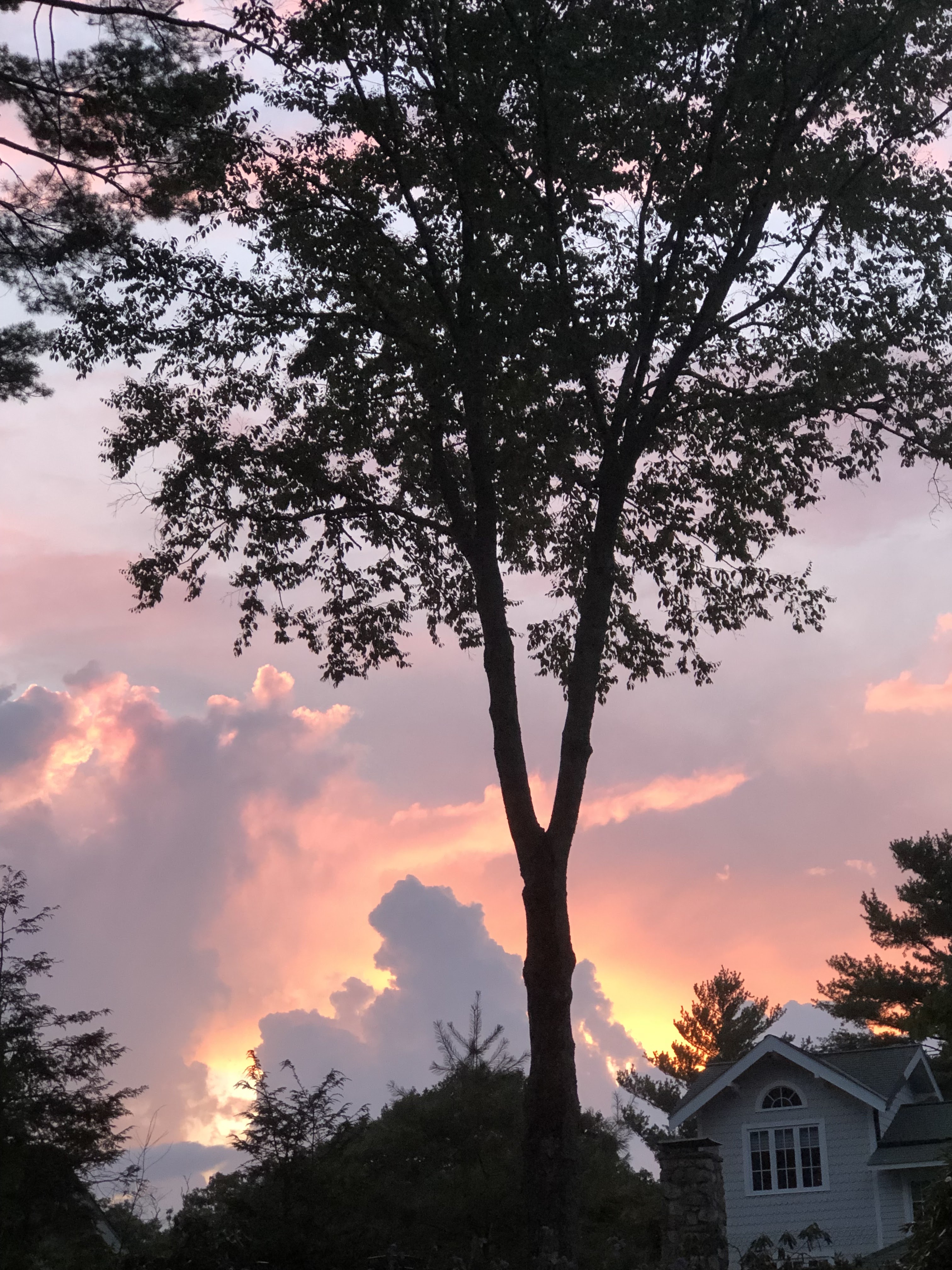
On a non-IWSG-related topic, my neighbors took down a bunch of dead hemlocks on their side of the property line and I'm tickled beyond belief. Now, rather than scraggily bushes, there's a clear view of  summer sunsets. I haven’t included many of pictures here lately, but the other day I took about fifty shots as a storm started to muscle in. Unbeknownst to me,  my daughter took a picture of her own.


Here's what I got.


Do you have a view of summer sunsets? What do you consider when you begin to write a story?

Wednesday, July 6, 2022

Tap, Tap, Tap - IWSG July 2022


Welcome to IWSG Day. The goal of this blog hop is to share and encourage. Writers can express doubts and concerns without fear of appearing foolish or weak. Those who have been through the fire can offer assistance and guidance. It’s a haven for insecure writers of all kinds. IWSG is the brainchild of the amazing and generous  Alex Cavanaugh. Thank you to co-hosts for July: J Lenni Dorner, Janet Alcorn, PJ Colando, Jenni Enzor, and Diane Burton! To read other contributors to IWSG click here.

July optional question: If you could live in any book world, which one would you choose?

In high school, I read a book called Celia Garth by Gwen Bristow, the fictional story of a young woman in Charleston during the American Revolution. It left me with a yearning to visit the South Carolina low country. Over the years since, I’ve read so many southern authors, Pat Conroy, Cormac McCarthy, Anne Rivers Siddons, Dorothea Benton Frank. If a book had the potential to mention a low country sunset, I was all in.

By the time my daughter moved to Charleston for a period and the chance came to visit, I could name the places I wanted to see –Trad Street, Rainbow Row, the Battery, Fort Sumpter, Sullivan’s Island, Folly Beach. She ended moving back there for a few years and through subsequent visits, I became familiar with the area. How I loved driving Route 17 from Charleston to Savannah and seeing kids casting shrimp nets by the side of the road, or slow trawlers waddling out to sea. I witnessed sunsets over winding creeks that were so beautiful they made me want to cry— it was all there everything I read about in those books I so enjoyed.

But would I want to live there? Well, no, but not because the location doesn’t speak to me. It’s just that I lean equally toward books that feature New England. Perhaps it’s the familiarity that draws me in. I feel blessed to live less than an hour from a metropolitan city, but also close to lobster boats, farmers, apple orchards and tumbled stone walls, plus so much history almost everywhere we walk we mark famous footsteps. Case in point, two participants of the Boston Tea Party are buried in my town cemetery.

The other morning, I sat at my computer drafting this piece and looked out the window to see a truck from the local dairy farm delivering fresh milk in glass bottles to my neighbors. Where else does this happen anymore? When I read books that take place in this world, it’s like my oldest best friend, coming to visit.

So, to answer this month’s question, I can only say this. I'll always welcome an opportunity to visit the low country, but as Dorothy  said so famously as she tapped her ruby slippers, “There’s no place like home.”


If you could live in any book world, where would you live?


Wednesday, June 1, 2022

Faith as a Writer


Welcome to IWSG Day. The goal of this blog hop is to share and encourage. Writers can express doubts and concerns without fear of appearing foolish or weak. Those who have been through the fire can offer assistance and guidance. It’s a haven for insecure writers of all kinds. IWSG is the brainchild of the amazing and generous Alex Cavanaugh. Thank you to the June co-hosts: SE White, Cathrina Constantine, Natalie Aguire, Joylene Nowell Butler, and Jacqui Murray!


June’s optional question: When the going gets tough writing the story, how do you keep yourself writing to the end? If you have not started the writing yet, why do you think that is and what do you think could help you find your groove and start?

The title of my very first blog post was “I Can Do This.” All these years later that theme continues to resonate through my writing life. Joyce Carol Oates wrote a book called Faith of a Writer. In truth, it’s not my favorite book on craft, but the title has always resonated with me. Faith in my writing allows me to slog through many a story-struggle because once I get something down, I know the result can be edited. So many initial and fairly awful attempts end up deleted or changed beyond recognition, but as long as there is something to work with, I know forward progress is possible. Case in point, my current novel was inspired by a small glass bottle we dug up from our backyard. That bottle has long disappeared from the story, but a draft novel resulted from that initial passage.

Sometimes, when the effort feels notably painful, rather than decide I can’t write, I give myself permission to think. Recently my writing group suggested one of my characters wasn’t giving my story complexity. I agreed but didn’t know how to give it to her. I spent many middle-of-the-night-I-can’t-sleep-hours pondering her—letting her drift around my mind until she obliged me by fleshing herself out. Once I make the changes those think-sessions suggested, she’ll be less wallpaper paste and become more of the pattern itself.

And finally, on pieces like this blog post when often I have no idea what I want to say, I start by writing stream of conscious. Most of that ends up as a pile of discarded word glop—which happened to the entire paragraph with which I initially started today’s post. But once I get something down, a nugget appears that informs me of the direction in which I need to go, and I follow its lead. The fun part is more often than not, I end up in a totally different place than where I thought I would land.

It’s a little like sculpting. I chisel away, cutting, pasting and editing, knowing the right words will emerge as long as I trust they are there.


How do you keep writing when the going gets tough?

Wednesday, May 4, 2022

Back to Earth - IWSG May 2022

Welcome to IWSG Day. The goal of this blog hop is to share and encourage. Writers can express doubts and concerns without fear of appearing foolish or weak. Those who have been through the fire can offer assistance and guidance. It’s a haven for insecure writers of all kinds. IWSG is the brainchild of the amazing and generous Alex Cavanaugh. Thank you to the May co-hosts: Kim Elliott, Melissa Maygrove, Chemist Ken, Lee Lowery, and Nancy Gideon! To find links to all IWSG contributors, click here.

This month’s question: It's the best of times; it's the worst of times. What are your writer highs? And what are your writer lows?

A few years ago, I signed up for Grub Street’s Muse in the Marketplace. Generally, I’m reluctant to attend conferences because when I arrive, my “I’m-nothing-but-a-fake” demon inflates inside me, but somehow that year I beat down my fear. I even signed up for a critique session which involved sending sample pages to an agent prior to the event.

In spite of high anxiety, the day was a success, the workshops outstanding and in my mind, my agent one-on-one went worlds better than expected. The woman I’d been partnered with seemed engaged. She offered me sound advice and even appeared regretful when our time was up. All I’d wanted that day was to sit with a professional and acquit myself competently, so when she asked me to send her partial of the book I was querying, I didn’t so much walk out of that meeting, I sailed. It was enough of a rush to have enjoyed the conference, but piquing an agent’s interest in my novel? That wasn’t just frosting on the proverbial cake, it was ice cream, homemade fudge sauce and a massive dollop of whipped cream, too. I sent my submission lickety split.

But that’s all she wrote—pun very much intended—because I received no follow up—no request to read more, no “Thanks, but no thanks.” Nothing. Zip.

Now in case you’re wondering, by that point I’d written three books and queried two. I’d received partial requests, full requests, every manner of form rejection and was no stranger to dead air. But that day, I let my guard down. I left the conference over the moon. My husband took me out to dinner that night and I couldn’t stop talking. I was so proud of myself for conquering my fears, and while I wasn’t expecting a book deal out of it, I was convinced the agent was enthusiastic. I thought at least I’d get a helpful letter telling me why she was rejecting my novel. But instead, I got nada. I emailed after a couple of months, crossing my fingers that the lack of communication was an oversight, but received no reply to my email either.

I get it. Agents drown in volume. One  needs to be a great writer with a unique concept with the best query, and it needs to land in front of the right person at the perfect time. I can’t imagine all the queries agents (or their assistants and interns) have to wade through. But darn it. That meeting filled me with hope. These days, the cynic in me figures I was naïve—that requesting a partial was that agent’s personal code for “no interest.” It was easier than saying “no” face-to-face to an eager author wanna-be.

So, there it is, a best and worst tied together. Nothing earth shattering. I keep writing. Periodically I rouse myself to query some more. But this month’s question triggered the memory of that happy day I blasted off like a skyrocket, only to drift to earth a few months later—wondering how I’d managed to fool myself into believing my agent meeting had been a success.